Game of the Generals: Origin and Beginnings
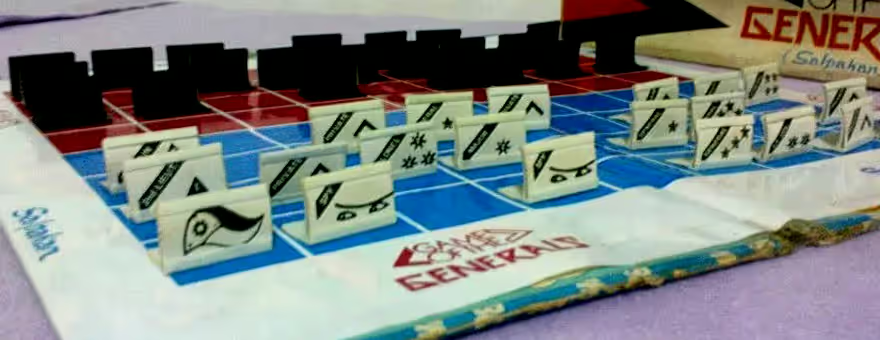
Back in the early 1970s, when the personal or home computer was a term still next to non-existent, kids and young adults contented themselves with pastimes like playing board games at home or for the more active, a round of Badminton or two. Aside from games like Snakes and Ladders for the quite young to Chess, Checkers, or the word-twisting Scrabble for the bit older, board games reigned supreme.
Among these games was a Military Strategy game that played like Chess but had a different set of rules. It was called "Game of the Generals" and unless you were living (or born) in the Philippines, chances are, you wouldn't have heard of it when it was officially released in 1973, until probably years later when it was adapted and made available in over 30 countries worldwide.
"Game of the Generals" is a brainchild of Filipino game designer Sofronio H. Pasola Jr. and his son Ronnie. A loose combination of Chess and playing card games, Game of the Generals (GoG) uses a tiled playing/battlefield that in a way is similar to Chess but of a different grid proportion. The Pasolas started developing and experimenting on the design in 1970 and through various play testing and improvements finally released it three years later.
Board and Pieces
Instead of Chess pieces or cards, the game used small folded pieces of plastic or metal (folded around 80 to 90 degrees) and small enough to fit on a grid tile. The side facing the opponent was blank but the side facing the player had a military rank (and insignia) printed on it. As Chess has King, Queen, Knights, and pieces all the way down to the Pawns, the Game of the Generals game pieces were similarly categorized as well.
The tiled (Chess-looking) game board has a total of 72 blank squares arranged in an 8 by 9 grid configuration. Again, like Chess, there are 2 opposing home sides and each player has 21 player pieces to randomly arrange within the first 3 rows of each home side. The arrangement will depend on the player (at least on the board game) with the foremost rule of having the blank side of each piece facing the opposing side so the enemy will have to guess what piece it is. This arrangement will have to be done within the first 3 rows from the homeside.
Now that we've discussed the board, we go to the pieces. As previously stated, there are 21 pieces on each side. Usually, plastic pieces are colored black and white (sides) like Chess, but in lieu of plastic, either silver or copper colored metal pieces are used.
The designation of each piece is by military rank from a 5 Star Gneral down to the Flag (usually the Philippine flag) which can be replaced by the flag of the country where the game is sold. The flag is the most important yet helpless piece in the game. Any other ranking piece from highest to lowest rank can (as in the Chess term) eat the flag.
The pieces are ranked accordingly through military designations but follow the Philippine Army ranking system, from 5 Star, 4 Star, 3 Star, 2 Star, and 1 Star General followed by the Colonel with 3 Sunbursts, Lt. Colonel, 2 Sunbursts, and a Major with 1 Sunburst. Then the junior officers follow with a Captain with 3 Triangles, 1st Lt., 2 Triangles, and the 2nd Lt. with a single Triangle. The NCO/Sergeant with three Chevrons follows then 6 Privates with a Chevron each. The pieces round up with 2 deadly Spies and a single Flag.
Playing the Game
Just like Chess, the game is turn-based. A piece can be moved forward, backward, or sideways but not diagonally. Movement is one tile at a time so you won't have a piece like the Queen that simply jumps all over the board. The objective is to maneuver your pieces to locations on the board with your opponent's pieces in order to eat them like in Chess.
However, you don't know what the rank of the enemy piece is, so, at least the board game will need a third person to act as an "Arbiter" who can see the ranks of both sides. When a move is made, the Arbiter will remove the losing piece from the board and return it to the player whom it belongs to without showing it to the other player who just ate it. This keeps the sides continuously guessing on the rank and value of their opponent's pieces.
When the Flag piece of a player is able to reach the innermost row of the enemy side without being attacked or eaten, the player wins the game. This is the equivalent of checkmate in Chess though in Chess, a Pawn reaching the innermost enemy row will afford the piece to be replaced by a Queen or another powerful piece of choice. If the Flag is however eaten by any other piece, the player loses.
The Pecking Order
In the game, the higher ranking piece survives the encounter except when it comes to the Spy. All officers will win against a Sergeant or Private but not the Spy. The Spy will win when confronted by an officer but will lose when up against a Private. The pecking order is straightforward, a General will definitely beat a Captain and a Captain will definitely beat a Sergeant or Private. A Flag will be eaten by all so you'll have to keep it safe as it can only win against the enemy flag if it strikes first.
A Game of Strategy and Chance
GoG is a game of both strategy and chance. You don't know the rank of an enemy piece but through moves and your pieces it eats, you begin to guess its rank. There is always a chance that your estimates could be wrong but with this knowledge alone, you can already formulate a strategy on how to move your pieces on the board.
You will have to carefully maneuver your flag to the winning row and likewise, a piece that the enemy seems to be protecting would likely be a flag as well. In many ways, the game is so similar to Chess except that you have to guess the identity of the opposing forces. The overall gameplay thus increases the intrigue, immersion, and addictive quality of the game.
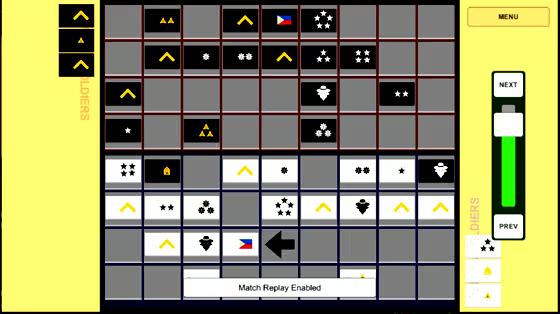
Game of the Generals has been around for a long time and over the years, both electronic handheld and digital versions of the game have been developed and released over the years. In a digital/mobile game, the Arbiter's role is taken over by the game itself so solo gameplay has become the norm if not an option. Despite all these ports and developments, the game is still widely played as a traditional board game where the players can go at it face to face, one on one, and with all the good-natured heckling, jeers, and fun found in a traditional socially oriented tabletop game.
Image Info:
https://boardgamegeek.com/image/311133/game-of-the-generals
https://play.google.com/store/apps/details?id=com.mawkins.gotg&hl=en